


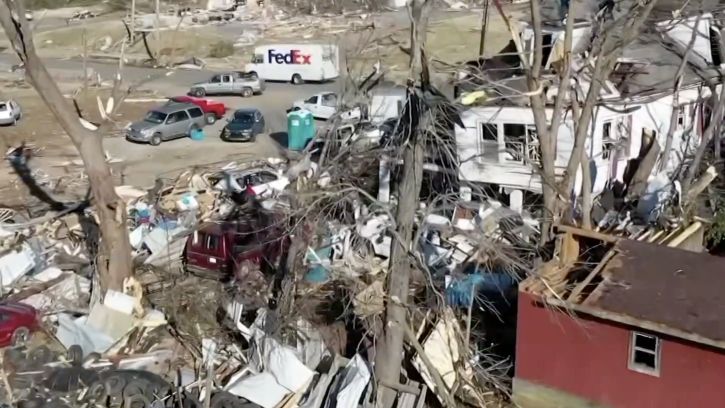
Experts say the tornadoes that recently ripped through the Midwest are evidence of a changing climate.
SUNY College of Environmental Science and Forestry associate professor Colin Beier drew an important distinction between climate and weather. The climate is the average conditions of a large area over a long period of time, while the weather is the here and now.
“Climate is what you expect, at a given time of the year, at a given place. Weather is what you get,” said Beier.
And the here and now weather is increasingly more extreme, as seen recently in the Midwest.
“It makes it hard to say this is directly because of climate change, but the increasing intensity and frequency of what we would call extreme weather, or even record-setting weather, does seem to be a pretty clear symptom of how our climate is changing,” said Beier.
The tornado that ripped through the Midwest Friday night and Saturday morning resulted in a death toll of at least 88 people in multiple states, mostly Kentucky.
The state’s governor called it the deadliest tornado in its history.
Beier says the weather is becoming more difficult to predict because of the changing climate and the frequency at which these once-considered outlier events seem to happen.
“We’re reminded we’re kind of at the mercy of a lot of this stuff, and even if those tornadoes or even if hurricane Sandy, which is widely talked about as climate change, it’s indicative of what we expect the future to be,” said Beier.
He says our models predicting weather should still be trusted.
“But these models have done an outstanding job. These groups have been modeling for decades and continually refining and improving things, but they’re really able to recreate the global and region weather patterns we’ve seen over the last several decades,” said Beier.
He says the evidence of a changing climate is available, but whether it’s enough to change public perception is another story.
“Science is not the ultimate truth, but it is a pretty effective way at getting at some truths,” said Beier.

