


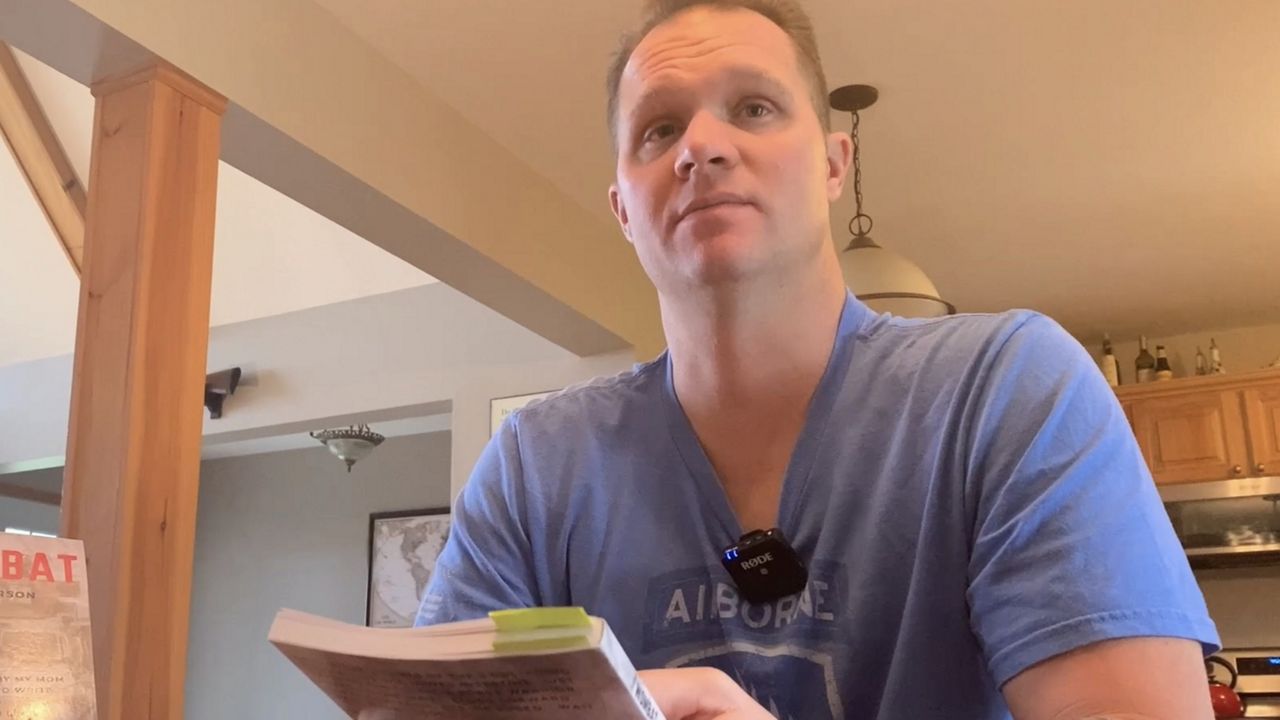
Chief Warrant Officer Edwin Anderson – call him Win – has been in the Army for 18 years. He’s been a pilot for the last dozen, flying $30 million Chinooks into war zones.
It’s critical he and his team understand every single aspect of these choppers, because while the machines are critical, the team is invaluable.
“It’s sort of a cliché, but people say what they really are fighting for, why they are in the military, and it’s for the person to the left and right of them more so than any big, broader ideal,” Anderson said. “It’s for the soldier to your left and right.”
Perhaps a cliché, but “Win” has lived that since that first day of boot camp in 2004, through more than four years in Afghanistan and now, as a team leader.
What You Need To Know
- CWO Edwin Anderson is a pilot with the 10th Mountain Division. He has been deployed to Afghanistan for 52 months of his life
- In a firefight, Anderson was shot in the helmet. It was one of many things that left him suffering from PTSD
- Anderson dealt with his pain with laughter, and has now written a book he hopes will help heal others
- Anderson’s book, WOMBAT, is now available on Amazon
Know each soldier to the left and right. Love each soldier to the left and right, because you never know. One day, that soldier in need could be you.
“It started on that second deployment,” Anderson said. “I was in the prone and I had my saw gunner next to me. We were engaged by enemy forces in several different locations, and I kind of craned my head up to try and get a better view of the enemy. At that point, I kind of heard like a burst of machine gun fire and my head snapped back. The bullet had hit me in the helmet, but at the time, I didn’t know how bad it was.”
Amazingly, the damage was not fatal.
“Just like a movie, I watched my vision tunnel into black,” he remembered, adding that his safety glasses began to fill with blood.
And while physical wounds do heal, that’s an experience you never forget. As so many soldiers do after suffering traumatic events, Win and those to his left and right would slowly, over the years notice everything with Win was not OK.
Post-traumatic stress disorder. PTSD.
He would talk with friends, his battle buddies, and even professionals, but thanks to a suggestion from his mother, Win found therapy … a happy place.
“For me, writing, actually getting some of these experiences and thoughts and feelings ultimately leading to the PTSD out of my head onto paper, physically helps me feel better about it, and ultimately, I hope that it will do the same for others,” he said.
It would not take long before Win realized his experiences and thoughts, both tragic and funny, would make a great book.
“To me, humor is a very powerful tool, and I think soldiers, in general, use it more than even they realize,” Anderson said.
After all, laughter is the best medicine. Maybe it really could help those to his left and right.
Born was Wombat, Anderson’s first book in which he shares stories of soldiers who had some trouble eating MRE’s, and even one time where he warned his team not to fall asleep, and he almost immediately fell asleep.
“Being able to wrap my mind around PTSD, but doing so in a humorous manner, and seeing that there’s still ways forward by literally laughing at your own difficulties,” Anderson said.
Because Win wonders, what else is there? You can either laugh or cry and fall apart.
Win’s book is available on Amazon.
He’s in the process of writing a second book and with proceeds, is planning on starting a fund to help veterans struggling with PTSD.

