


NYC Public Housing Crime Hits Record Lows as Hochul Touts Safety Investments
New NYPD figures show historically low levels of several violent crimes in city housing developments, while New York State points to more than $150 million committed to additional NYPD resources.
NEW YORK — NYC public housing crime reached record lows for murders, shootings, shooting victims and robberies during the first seven months of 2026, according to newly released NYPD data highlighted this week by Gov. Kathy Hochul and Police Commissioner Jessica Tisch. The numbers offer measurable evidence of declining violence in communities where residents have long demanded both greater safety and a stronger relationship with law enforcement.
The statistics are significant. Between January and July, major crime in New York City public housing fell 6.3 percent, from 3,387 reported offenses during the same period in 2025 to 3,174 this year.
During that same seven-month period:
- Murders fell 45 percent, from 20 to 11.
- Shooting incidents dropped 33.3 percent, from 81 to 54.
- Shooting victims declined 35.2 percent, from 91 to 59.
- Robberies dropped 19.3 percent, from 519 to 419.
The NYPD separately reported on Aug. 3 that the totals for murders, shootings, shooting victims and robberies were the lowest recorded for the first seven months of any year in New York City’s public housing developments. That independent NYPD announcement corroborates the central crime figures cited by the governor.





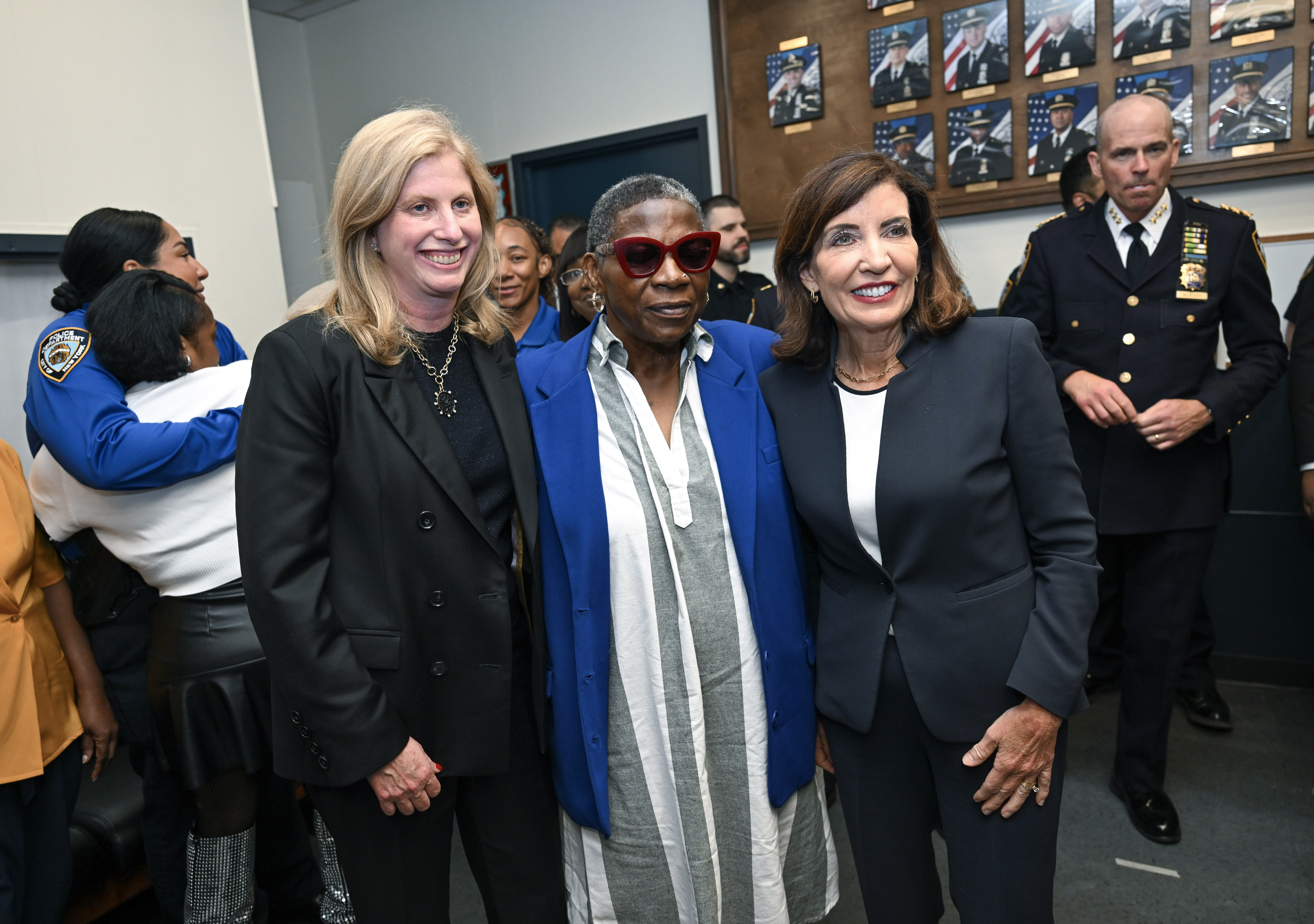


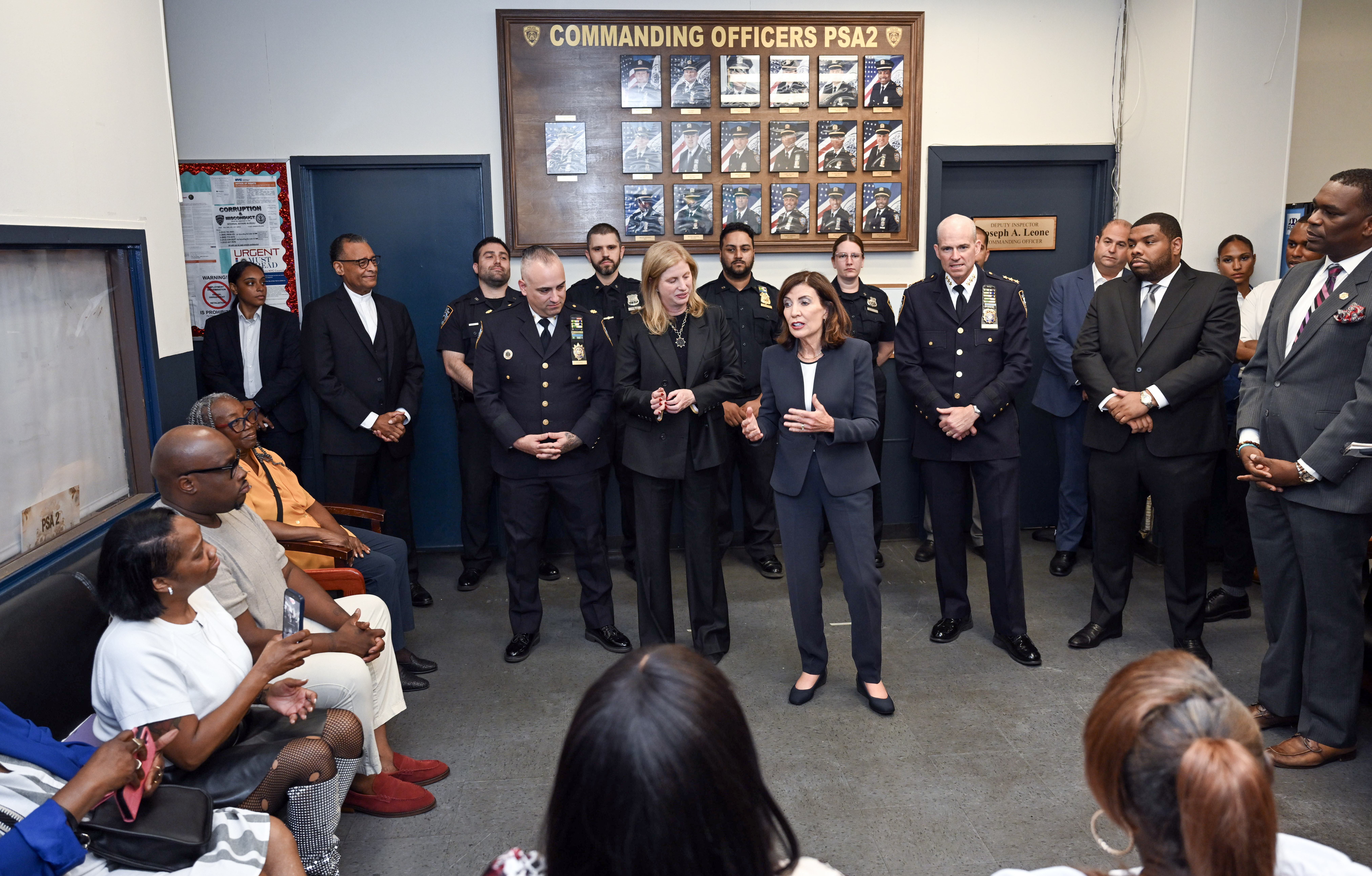


Hochul Points to More Than $150 Million for NYPD
Hochul and Tisch highlighted the numbers during an Aug. 18 visit to Police Service Area 2 in Brooklyn North.
The governor’s office said New York State has invested or committed more than $150 million in additional NYPD resources since 2025. That total includes $77 million already provided in fiscal year 2026 and another $77 million commitment announced this year.
Hochul described public safety as a central priority of her administration.
“Every dollar we invest and every partnership we build strengthens our efforts to make New York safer,” Hochul said, crediting Tisch and law-enforcement officers for helping drive down crime.
According to the governor’s office, the funding helps the NYPD maintain roughly 5,000 hours of Enhanced Transit Safety Overtime each day and supports additional officers and mobile units on trains and subway platforms.
The state’s spending totals are figures reported by the Hochul administration. The crime statistics themselves are also published separately by the NYPD.
Brooklyn North Posts Particularly Sharp Declines
Hochul and Tisch visited PSA 2, which patrols 42 public housing developments within the NYPD’s 73rd, 75th and 77th precincts.
The area recorded some of Brooklyn’s strongest reductions this year.
Shooting incidents within PSA 2 declined 40 percent, while the number of shooting victims fell 45.5 percent compared with the same period in 2025, according to the governor’s office.
The NYPD Housing Bureau has responsibility for policing city housing developments and works with resident patrols, community organizations and development managers. State officials estimate that nearly half a million residents, workers and visitors fall within the Housing Bureau’s service area.
Decline Is Part of a Broader NYC Crime Trend
The improvement is not confined to public housing.
The NYPD reported that major crime across New York City declined 6.6 percent during the first seven months of 2026, falling from 69,951 reported major crimes during the corresponding period in 2025 to 65,343 this year.
July was particularly strong. Major crime fell 12.7 percent citywide compared with July 2025, with decreases reported in all seven major crime categories and every borough.
The city also recorded historic lows for shootings and murders during the first seven months.
For context, the NYPD reported:
- 381 citywide shooting incidents through July 2026, down from 412 in 2025.
- 59 shooting incidents in July, down from 75 the previous July.
- July shootings were about 75 percent lower than in July 2020, when the city recorded 243 shooting incidents.
The longer-term trend in public housing has also been visible throughout the year. At the end of June, the NYPD reported major crime in public housing was already down 9 percent compared with the first half of 2025.
Nearly $4 Billion in Statewide Public-Safety Spending
Hochul is also tying the New York City results to a much broader statewide public-safety strategy.
Her administration says New York has invested nearly $4 billion in public-safety programs since she took office, including spending on gun-violence prevention, law-enforcement technology, prosecutors, public defenders, subway safety and other initiatives.
According to figures released by the governor’s office, comparing January through March 2026 with the same period in 2022, statewide index crime fell approximately 10 percent, with declines across all seven major categories.
The administration also reported that, comparing January through July 2026 with the same period in 2022, shooting incidents involving injury declined 57 percent, the number of people shot fell 57 percent and shooting deaths declined 62 percent.
Those statewide comparisons use 2022 — Hochul’s first full calendar year as governor — as the baseline.
What the Numbers Do — and Do Not — Tell Us
The decline deserves attention, but statistics should be interpreted carefully.
Crime data measure offenses reported to and recorded by law enforcement. They are an important way to track public safety, but they cannot by themselves determine precisely why crime rises or falls.
State officials credit increased law-enforcement resources, targeted policing and violence-prevention initiatives. NYPD officials have similarly pointed to what they call data-driven or “precision policing,” gun seizures and efforts targeting violent groups.
Other factors can also influence crime trends, including economic conditions, neighborhood-level programs, demographics, social services and changes in criminal behavior.
That distinction matters.
The available figures establish that several serious crimes have fallen substantially. They do not, by themselves, prove that any single policy or funding increase caused the entire reduction.
Public Housing Residents Have the Most at Stake
For people living in public housing, the importance of these numbers goes well beyond political talking points.
Eleven murders instead of 20 means nine fewer recorded homicides during the first seven months compared with last year. Fifty-nine shooting victims instead of 91 means 32 fewer people recorded as victims of gunfire.
Those are not abstract percentages. They represent people, families and neighborhoods.
At the same time, lasting public safety requires more than reaching a statistical milestone. Residents must be able to feel secure walking to a subway station, allowing children to play outside, returning home after dark or simply spending time in their own neighborhood.
That means maintaining accountability while continuing investments in policing, violence prevention, youth programs, mental-health services and resident-led community initiatives.
A Record Worth Building On
The most encouraging part of the latest NYPD report is not the political victory it may offer any elected official. It is the direction of the numbers themselves.
Fewer murders. Fewer people shot. Fewer robberies.
The first seven months of 2026 show that New York City’s public housing developments experienced historically low levels of several serious crimes, according to NYPD records.
Now comes the harder test: sustaining those improvements.
Government leaders should continue publishing detailed crime data so residents and taxpayers can judge which strategies work. Public-safety funding should also be measured not simply by how much government spends, but by whether communities become safer, residents trust the institutions serving them and fewer families experience violence.
For New Yorkers, that is the measure that matters most.
SOURCES
Key information was verified against:
- New York State Office of the Governor, Aug. 18, 2026 public-housing crime and NYPD funding announcement.
- New York City Police Department, Aug. 3, 2026 seven-month crime report.
- NYPD public-housing and citywide crime reports from June and July 2026.
- New York State Office of the Governor statewide public-safety investment report.
- NYPD Citywide Crime Statistics portal, which publishes weekly citywide and NYCHA crime reports.
Featured Image Alt Text: NYC public housing crime reaches record lows as murders, shootings and robberies decline in 2026.
