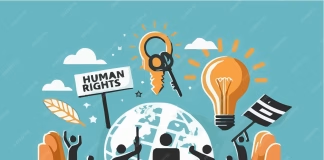
I recently read an opinion piece in USA Today that argued the increase in California’s minimum wage would likely lead to businesses shutting down or laying off workers, suggesting that the concept of providing a living wage is detrimental to our economy. I find this perspective fundamentally flawed. Given that corporations are amassing billions in profits, and their executives and board members live in opulence, it’s difficult to reconcile this wealth with the reality that average workers struggle to afford basic necessities, often resorting to food banks and living in substandard housing. The argument that $2 billion in profit isn’t sufficient is perplexing. Furthermore, the practice of “Aggressive Pricing,” where companies raise prices simply because they can, exacerbates this disparity. It’s my belief that American business owners should implement profit-sharing or other incentives to ensure their workers are content and productive. The notion of a “starter job” is obsolete in today’s America; every job is essential for survival and living paycheck to paycheck.
Minimum wage workers in America face numerous challenges and struggles as they try to make ends meet. This blog post aims to shed light on their experiences and highlight the need for economic justice. By examining the reality of living poor in America, the impact of corporate greed, the unrealistic definition of poverty, the shrinking middle class, the myth of job creation, the cost of inequality, and the struggles of making ends meet, it becomes clear that raising the minimum wage is crucial for achieving economic justice.
Key Takeaways
- Minimum wage workers in America are living in poverty and struggling to make ends meet.
- Corporate greed is a major factor contributing to the low wages of minimum wage workers.
- The definition of poverty is unrealistic and does not accurately reflect the struggles of minimum wage workers.
- The middle class is shrinking, making it harder for people to move up from minimum wage jobs.
- The myth of trickle-down economics and job creation by the rich is not supported by evidence.
Living Poor in America: The Reality of Minimum Wage Workers
According to data from the Bureau of Labor Statistics, approximately 1.6 million workers in the United States earn the federal minimum wage of $7.25 per hour. This translates to an annual income of just over $15,000, which is well below the poverty line for a family of two or more. Many minimum wage workers struggle to afford basic necessities such as housing, healthcare, and education.
For example, housing costs have skyrocketed in many parts of the country, making it nearly impossible for minimum wage workers to find affordable housing. They often have to live in substandard conditions or overcrowded apartments just to make ends meet. Additionally, healthcare costs continue to rise, making it difficult for minimum wage workers to access necessary medical care. And when it comes to education, many minimum wage workers cannot afford to further their education or provide their children with quality education opportunities.
 Corporate Greed: The Impact on Minimum Wage Workers
One of the main reasons why minimum wage workers struggle is because corporations prioritize profits over fair wages for their employees. Many large corporations pay their CEOs exorbitant salaries while their workers earn poverty wages. This greed not only perpetuates income inequality but also has a negative impact on the economy and society as a whole.
When corporations prioritize profits over fair wages, it leads to a concentration of wealth among a small percentage of the population. This concentration of wealth leads to a decrease in consumer spending, as the majority of people have less disposable income. This, in turn, leads to a decrease in demand for goods and services, which can have a negative impact on businesses and the overall economy.
The Unrealistic Definition of Poverty: How it Affects Minimum Wage Workers
| Metrics | Data |
|---|---|
| Number of minimum wage workers in the US | 1.6 million |
| Current federal minimum wage | 7.25 per hour |
| Living wage for a single adult in the US | 16.54 per hour |
| Percentage of minimum wage workers who are women | 62% |
| Percentage of minimum wage workers who are people of color | 40% |
| Percentage of minimum wage workers who are parents | 33% |
| Percentage of minimum wage workers who work full-time | 60% |
| Percentage of minimum wage workers who are under the age of 25 | 50% |
| Percentage of minimum wage workers who have some college education or more | 36% |
The current definition of poverty in America is unrealistic and outdated. The federal poverty line is based on a formula that was developed in the 1960s and does not take into account the rising cost of living or regional differences in expenses. As a result, many minimum wage workers who are technically above the poverty line still struggle to make ends meet.
This unrealistic definition of poverty also affects minimum wage workers’ ability to access government assistance programs. Many of these programs have strict income eligibility requirements that are based on the federal poverty line. As a result, many minimum wage workers do not qualify for assistance even though they are living in poverty.
The Middle Class Now vs 20 Years Ago: The Shrinking of the Middle Class
Over the past few decades, the middle class in America has been shrinking. According to data from the Pew Research Center, the share of adults living in middle-income households has decreased from 55% in 2000 to 51% in 2019. This trend has had a significant impact on minimum wage workers and their ability to move up the economic ladder.
As the middle class shrinks, there are fewer opportunities for upward mobility for minimum wage workers. Many jobs that used to provide a pathway to the middle class now pay poverty wages. This means that even if minimum wage workers work hard and try to improve their skills, they may still struggle to escape poverty.
The Rich Does Not Believe in Trickle Down: The Myth of Job Creation

One of the arguments often used against raising the minimum wage is that it will lead to job losses. This argument is based on the myth of trickle-down economics, which suggests that if the rich have more money, they will create more jobs. However, this theory has been debunked by numerous studies and real-world examples.
In reality, the rich do not necessarily create jobs. Instead, job creation is driven by consumer demand. When people have more money to spend, they can afford to buy goods and services, which creates a demand for those goods and services. This, in turn, leads to job creation as businesses hire more workers to meet the increased demand.
The Impact of Low Wages on the Economy: The Cost of Inequality
Low wages have a significant impact on the economy as a whole. When workers earn poverty wages, they have less disposable income to spend on goods and services. This leads to a decrease in consumer spending, which can have a negative impact on businesses and the overall economy.
Additionally, low wages contribute to income inequality. When a small percentage of the population earns a disproportionate amount of wealth, it leads to a concentration of wealth and power. This concentration of wealth can have negative social and political consequences, as it can lead to increased social unrest and decreased social mobility.
The Struggles of Minimum Wage Workers: The Challenges of Making Ends Meet
Minimum wage workers face numerous challenges in making ends meet. They often have to work multiple jobs or long hours just to cover their basic expenses. Many struggle to afford housing, healthcare, and education for themselves and their families.
For example, Sarah is a single mother who works full-time at a minimum wage job. She struggles to afford rent for her small apartment and often has to choose between paying for groceries or paying for her daughter’s school supplies. Sarah’s long hours and financial stress take a toll on her mental and physical health, leading to increased stress and fatigue.
The Importance of Raising the Minimum Wage: A Call to Action
Raising the minimum wage is crucial for achieving economic justice. It would provide minimum wage workers with a livable income and help lift them out of poverty. Additionally, raising the minimum wage would stimulate the economy by increasing consumer spending and creating more demand for goods and services.
Furthermore, raising the minimum wage would reduce income inequality and promote social and economic mobility. It would provide minimum wage workers with more opportunities to improve their skills and move up the economic ladder. This, in turn, would lead to a more equitable society and a stronger economy.
The Need for Economic Justice
In conclusion, minimum wage workers in America face numerous challenges and struggles as they try to make ends meet. The impact of corporate greed, the unrealistic definition of poverty, the shrinking middle class, the myth of job creation, and the cost of inequality all contribute to their difficulties. Raising the minimum wage is crucial for achieving economic justice and providing minimum wage workers with a livable income. It is time to take action and support policies that promote economic justice for all.
FAQs
What is the current minimum wage in the United States?
In 2023, the federal minimum wage is $7.25 per hour. However, some states and cities have set their own minimum wage rates that are higher than the federal rate.
What percentage of American workers earn minimum wage?
According to the Bureau of Labor Statistics, in 2020, about 1.9 million workers in the United States earned the federal minimum wage or less, which represents 1.9% of all hourly paid workers.
What are the impacts of low wages on minimum wage workers?
Low wages can lead to financial insecurity, difficulty in paying for basic necessities such as housing, food, and healthcare, and limited opportunities for career advancement. Minimum wage workers may also experience stress, anxiety, and poor mental health due to financial struggles.
What does it mean to live paycheck to paycheck on minimum wage?
Living paycheck to paycheck on minimum wage means that a person’s income is just enough to cover their basic expenses, such as rent, utilities, and food, with little or no money left over for savings or unexpected expenses.
What are some of the struggles faced by minimum wage workers in America?
Minimum wage workers in America may struggle to make ends meet, afford healthcare, pay for education, and save for retirement. They may also face discrimination, lack of job security, and limited opportunities for career advancement.
What is income inequality in the United States?
Income inequality refers to the unequal distribution of income among individuals or households in a society. In the United States, income inequality has been increasing over the past few decades, with the top 1% of earners receiving a disproportionate share of the country’s wealth.
What are the effects of low wages on the economy?
Low wages can lead to decreased consumer spending, as workers have less money to spend on goods and services. This can in turn lead to slower economic growth and job creation. Additionally, low wages can contribute to income inequality and social unrest.
My Final Thoughts
In America today, the urgency to stand up against the perpetuation of low wages and the pervasive influence of corporate money in our politics has never been more critical. Our democracy thrives on the active participation of its citizens, and casting our vote is a powerful tool in advocating for fair wages and a political system that prioritizes people over profits. It’s easy to feel disillusioned when the candidates don’t perfectly align with our ideals, but abstaining from voting only amplifies the voices of those who benefit from the status quo. Every election presents an opportunity to push for progress and to hold our leaders accountable. Remember, voting is not merely a right; it is a duty. By engaging in the electoral process, we can collectively fight for a future where economic justice and political integrity are not just ideals, but realities. Let’s not sit this one out. The stakes are too high, and the power of our collective action can bring about the change we so desperately need.