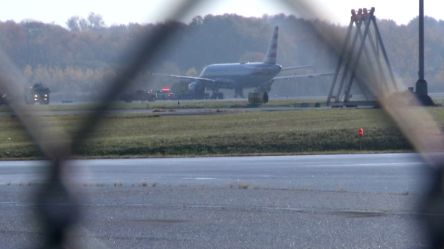
There’s still more to learn about 5G networks and how they’ll affect the daily lives of Americans, as evidenced by some red flags that have gone up in the aviation industry over the last 24 hours.
Technology has dramatically advanced in recent years, but unfortunately for airports in the Empire State and across the nation, it’s now become a point of contention.
“Major international carriers have already canceled flights and cargo shipments,” said Chris Oswald, senior vice president of safety and regulatory affairs at the Airports Council International – North America, “for fear they won’t be able to safely land aircraft at U.S. airports because of interference from 5G.”
The council is just one of the organizations raising red flags as Verizon and AT&T boot up high-powered networks for streaming, conferencing and research.
The networks operate on different frequencies than traditional cell service, and therein lies the issue.
“There are concerns that these new bands, what they call mid-bands, could interfere with avionics on an aircraft,” said Nuair President and CEO Ken Stewart, who works with the Federal Aviation Administration (FAA) and different regulatory organizations on a daily basis.
Stewart said he hasn’t found any evidence showing 5G crosses over to interfere with those systems, and likened the situation to something a little bit closer to the ground.
“There’s a two-lane highway. They might have just a little strip of grass in the middle,” Stewart said. “But then there’s interstates that have broad strips of grass in there, right, so, really, your odds of one lane interfering with another lane of traffic are pretty slim, and that’s kind of the case we’re looking at here.”
The issue is being sorted out even as towers for 5G are flipping on across the nation.
Airports like Hancock International in Syracuse are feeling it more than others.
“The FAA right now has put in place some restrictions to operate aircraft into airports and low visibility, so we are one of those airports on the list,” said Jason Terreri, executive director of the Syracuse Regional Airport Authority at the Syracuse Hancock International Airport.
For those trying to land in, let’s say a snowstorm or rain event across the Empire State, that’s a major issue.
Terreri said it’s on manufacturers and airlines to bring operations up to code.
“The aircraft manufacturers are the ones that have to file for this mock certification,” Terreri said. “If they get it, then they can operate that aircraft. It’s specific to the type.”
There is common ground. Everyone is intent beyond a shadow of a doubt that safety remains paramount.
“There’s 40 other countries that have deployed 5G, and don’t see an issue,” Stewart said. “So I think the key there is let’s be safe. I think the other part is, let’s get the FCC and the FAA together to get this problem solved before it becomes an issue.”
The FAA is working with manufacturers and organizations to clear more planes for low-to-no visibility safe landings.
“The FAA issued new approvals Wednesday that allow an estimated 62% of the U.S. commercial fleet to perform low-visibility landings at airports where wireless companies deployed 5G C-band,” the FAA said in a statement. “The new safety buffer announced Tuesday around airports in the 5G deployment further expanded the number of airports available to planes, with previously cleared altimeters to perform low-visibility landings. The FAA early Wednesday cleared another three altimeters.”