


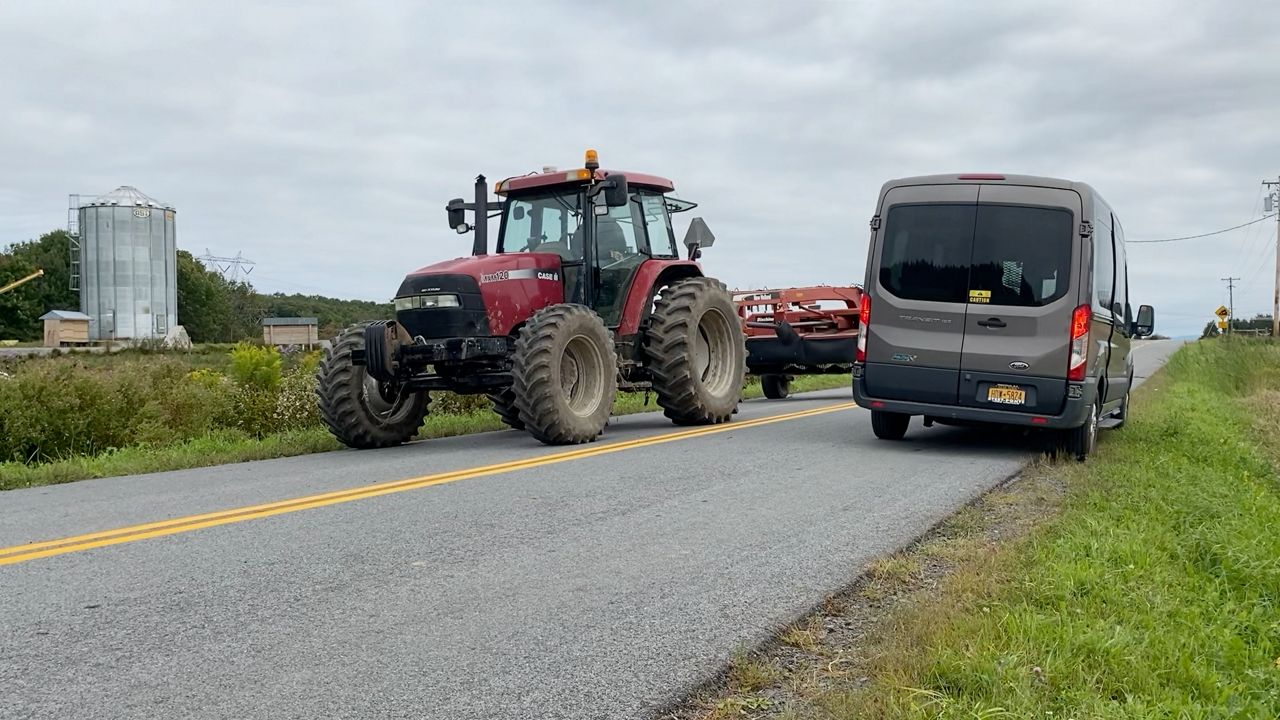
Roadway crashes with agricultural vehicles are five times more likely to be fatal than crashes that are non-agricultural, according to results shared in 2019 from a New York Center for Agricultural Medicine and Health study. Because of the severity, New York changed its laws, and local farmers are reminding drivers that they need to know the rules of the road.
Ben Simons has known farming his whole life. He works with his son, Chris Simons, at their family farm in Remsen. When taking agricultural vehicles on the road, Chris Simons says drivers try to illegally pass him all the time.
“I deal with it 24/7, and the best way to handle it is you almost gotta be out in the middle of the road and make it seen that you’re oversized, because cars don’t expect it, so you’ve got to make it a point to get off the road when you can, but we can’t always get off the road,” he said.
Chris Simons says farmers have to plan their routes around heavy traffic times. He says drivers don’t realize the dangers of passing illegally. The farm vehicle could be about to turn left, there could be oncoming traffic, and on top of it all, often, the farmer can’t see the cars behind them.
“Not only are we watching for the cars coming at us, but we’ve got to watch for the mailboxes that are on the side of the road,” Chris Simons said. “So often times, we’re swerving in and around mailboxes just to get down the road.”
Ben Simons says it became such a problem, New York State laws were revised in 2019. He was part of the group working on the laws.
One of the new laws is that all slow-moving vehicles (traveling under 40 mph) must have an emblem.
“There is a manual out now. It is called the ‘Slow-Moving Vehicle Guide,’” Ben Simons said. He says it’s available for free at sheriffs’ offices across the state.
Ben Simons says there is an exception for some animal-powered vehicles, but they still need reflective tape.
“They have to have 72 inches of reflective material on their buggies,” he said.
It is illegal to pass a slow-moving vehicle on roads with double yellow lines.
“That road is for all of us,” Ben Simons said. “We pay taxes, you pay taxes. That road also takes us to our job, as well as it does you. You go to and from your work on that road. We also go to and from our fields which is our work.”
He says it’s important farmers know their responsibilities, too.
He says farmers should not drive on the edge of the road and encourage drivers to illegally pass when there are double yellow lines. Ben Simons also stresses that people should not put slow-moving vehicle emblems in driveways.

