


Today’s Top Stories
1
Can You Solve Our Riddle of the Week?

2
The Best Sci-Fi Movies on Netflix Right Now

3
USS Tripoli Is Navy’s New Amphibious Assault Ship

4
Hummingbirds Can See Colors We Humans Can’t

5
This Modern Adirondack Is a Woodworking Challenge
Gear-obsessed editors choose every product we review. We may earn commission if you buy from a link. How we test gear.
Here’s everything the intrepid spacecraft has taught us about the distant dwarf planet.
Jul 14, 2020 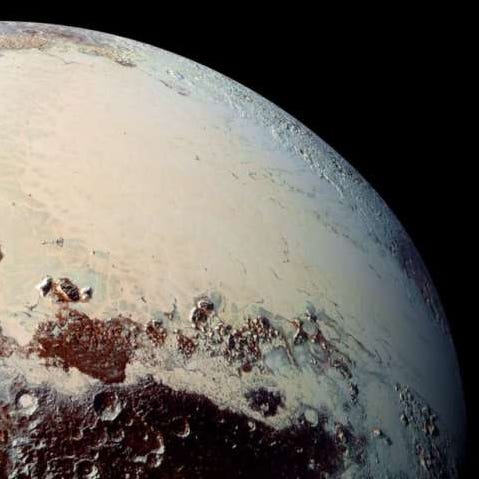
NASA/Johns Hopkins University Applied Physics Laboratory/Southwest Research Institute
On July 14, 2015, the New Horizons spacecraft zipped past Pluto, snapping stunning pictures of the dwarf planet and its moons. It took almost 10 years for the spacecraft, which launched on January 19, 2006, to get there.
The flyby revealed a wealth of information about the icy world, including its bright blue atmosphere, massive nitrogen glacier, and young surface, and shed light on the nearby moons Charon, Nix, and Hydra. Five years later, we celebrate nine of the groundbreaking discoveries that New Horizons made.
The spacecraft is still racing across our solar system and has taken detailed images of Arrokoth, a distant Kuiper Belt object. We’re excited to see what the hardy instrument spies next.

NASA/JHUAPL/SwRI
1 of 9
Pluto Is (a Bit) Larger Than We Thought
When scientists discovered the dwarf planet Eris to be bigger than Pluto in 2006, it marked the start of Pluto’s demotion from planetary status.
The New Horizons flyby revealed that Pluto is, in fact, larger than Eris—but not by much. Pluto’s diameter is a whopping 1,473 miles across compared to Eris’s 1,445-mile-wide diameter. Sorry, folks: This still doesn’t mean Pluto will become a planet again.

NASA / JHU-APL / SWRI
2 of 9
Pluto’s Nitrogen Glacier Is the Largest Known Glacier in the Solar System
Pluto’s stunning Sputnik Planitia, made from nitrogen ice (compared to Earth’s water ice glaciers), stretches for about 600 miles along the left lobe of the heart-shaped Tombaugh Regio region. The vast flows of slow-moving ice are also crater-free, meaning they’re extremely young.

NASA/JHUAPL/SwRI
3 of 9
There Is *Some* Water Ice on Pluto
New Horizons also spotted evidence of water ice on the distant world. The spacecraft’s Ralph spectral composition mapper detected several regions of exposed ice near the dwarf planet’s Tombaugh Regio region.
Water ice is pretty rare, though. Researchers believe there may be more water ice buried beneath ice flows made from other elements.
“Understanding why water appears exactly where it does, and not in other places, is a challenge that we are digging into,” science team member Jason Cook, of Southwest Research Institute, said in a statement announcing the discovery.
NASA-JHUAPL-SwRI
4 of 9
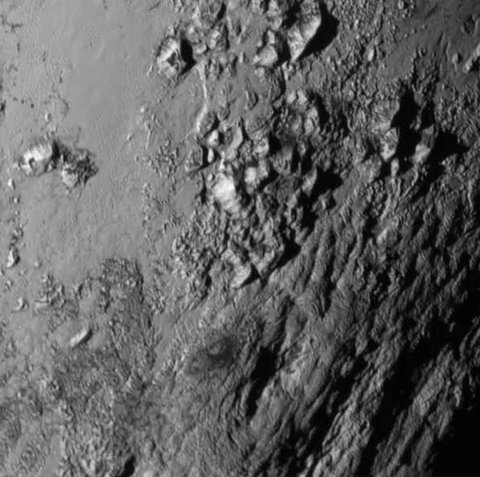
Pluto Has Mountains As Tall As the Rockies
Pluto is relatively young and active. The distant world has ranges of ice mountains as high as the Rocky Mountains here on Earth. This, paired with the surprising lack of craters, suggests the dwarf planet is still geologically active.
But what drives this cold, frigid world to be so geologically active? Could it be a subsurface ocean? Researchers are still puzzled.

NASA/JHUAPL/SwRI
5 of 9
Pluto’s Atmosphere Is Escaping Into Space
When New Horizons swept by Pluto, it took pictures of and collected data about the dwarf planet’s atmosphere. It’s composed mainly of nitrogen, with traces of methane and carbon monoxide.
Through a process called hydrodynamic outflow, though, Pluto’s nitrogen atmosphere is escaping into space at a rapid pace, according to Vox. Researchers could tell because an instrument on the spacecraft captured evidence of nitrogen atoms farther away from the planet than expected.

NASA/JHUAPL/SwRI
6 of 9
It’s Also Bright Blue!
Pluto’s atmosphere is filled with hydrocarbon particles called tholins, which scatter sunlight and create a bright blue hue. This image was taken by New Horizon’s Long Range Reconnaissance Imager (LORRI) and was paired with four-color filter data from the Ralph/Multispectral Visible Imaging Camera. Thanks to its atmosphere, Pluto is also much colder than scientists expected, according to a 2017 study.
NASA/Johns Hopkins University Applied Physics Laboratory/Southwest Research Institute
7 of 9
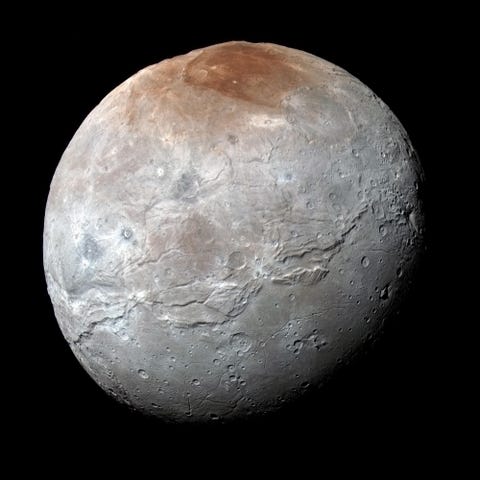
Pluto’s Moon Charon Is a Wild World
Charon is the other half of our solar system’s only known planetary system. New Horizons’s data suggests Charon may actually have a liquid ocean beneath its icy crust. Specifically, massive extensional tectonic belts along Charon’s equator indicate the moon could have, at one point, harbored a vast sea beneath the ice.

NASA/Johns Hopkins University Applied Physics Laboratory/Southwest Research Institute
8 of 9
Thanks to Pluto, Charon Has a Bright Red Cap
Charon’s characteristic red cap also stunned scientists. Observations have revealed this patch of red material atop the moon is the result of gases—mostly methane and other hydrocarbons—that have been expelled off of Pluto and accumulated on the nearby moon.

NASA/JHUAPL/SwRI
9 of 9
Hydra and Nix Contain Multitudes
New Horizons also captured the first close-up images of Pluto’s moons, Nix and Hydra. Hydra, shown here, has a highly reflective surface, leading researchers to believe it’s mostly made of water ice. Nix, on the other hand, has a reddish hue, which researchers believe could be the result of massive impact crater.
Next
The 10 Best Asteroids You Need To Know

Advertisement – Continue Reading Below
This content is created and maintained by a third party, and imported onto this page to help users provide their email addresses. You may be able to find more information about this and similar content at piano.io
This commenting section is created and maintained by a third party, and imported onto this page. You may be able to find more information on their web site.

