


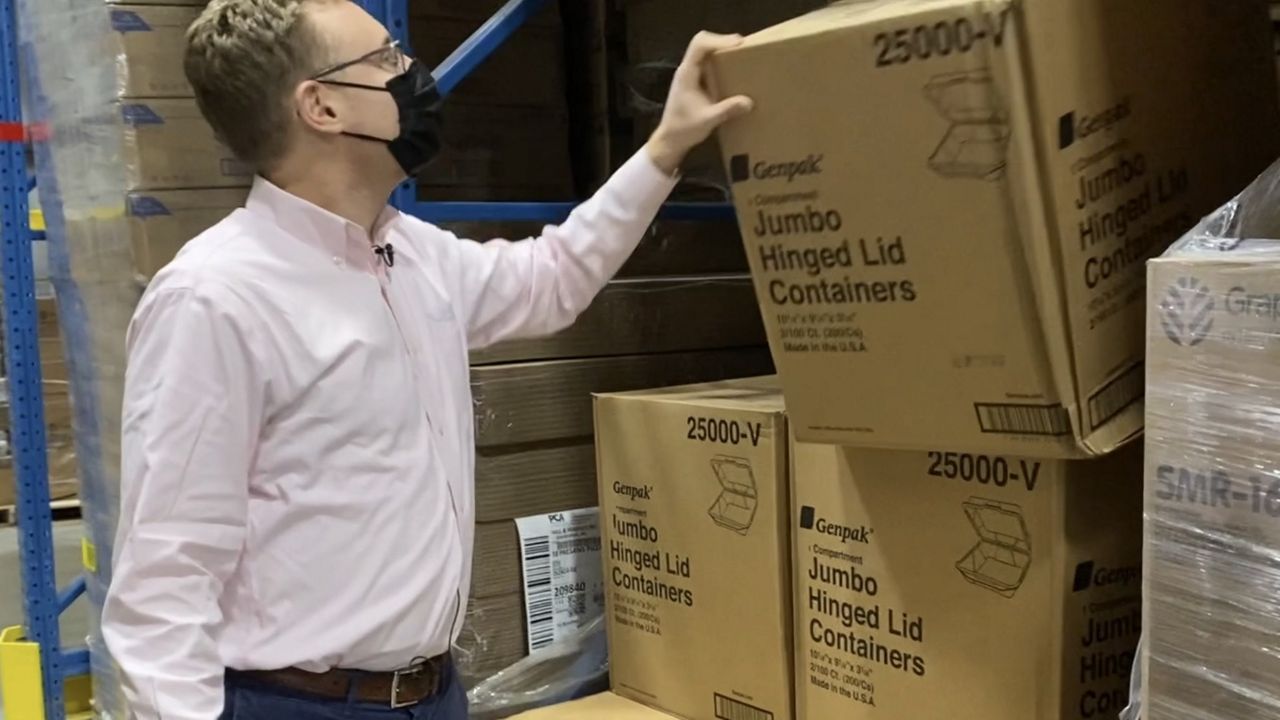
As Jason Packer walked around the massive warehouse of Hill & Markes, the CEO could only find about a month’s inventory of polystyrene foam products.
“We’re really working hard to deplete our inventory on foam right now,” Packer said.
The Montgomery County wholesale distributor is preparing to make the transition from foam to eco-friendly and recyclable products. That’s because the ban on single-use foam food and beverage containers takes effect on Jan. 1.
However, there’s one problem Packer has been running into — getting enough of the eco-friendly and recyclable containers, which he blamed on supply chain issues. Because of the shortage, he says businesses that need these containers could run into issues come 2022.
“Our concern is for our customers to be able to have the products they need to be able to service their customers,” Packer said.
He and other business owners expressed the concerns to the Adirondack Regional Chamber of Commerce. Last month, chamber President Michael Bittel wrote a letter to Gov. Kathy Hochul, asking for a one-year delay on the ban going into effect.
“Our local community wants to do the right thing,” Bittel said. “Our local restaurants want to be friendly to the environment. We just need to fetter this through.”
Bittel said pushing the ban to begin in 2023 would allow businesses to use their remaining Styrofoam containers while having more time until the eco-friendly products are obtainable.
He said what they’re trying to avoid is not being able to use the old product while still waiting for the new supply to arrive.
“Either we’re going to go directly into the landfill with these and not use them, our point is let’s use these,” Bittel said.
A financial hardship waiver can be granted by the state Department of Environmental Conservation if certain criteria are met. That includes community meal programs, food pantries, churches, or having an annual gross income under $500,000 per location.
Packer says he’s for the ban, but just needs a little extra time until supplies get moving again.
“We believe that over the next six months to 12 months, there will be a significant change in the supply chain, meaning there will be more labor in the labor force. The congestions at the ports will be cleaned up,” Packer said. “That will allow us to end have a complete supply chain.”

