


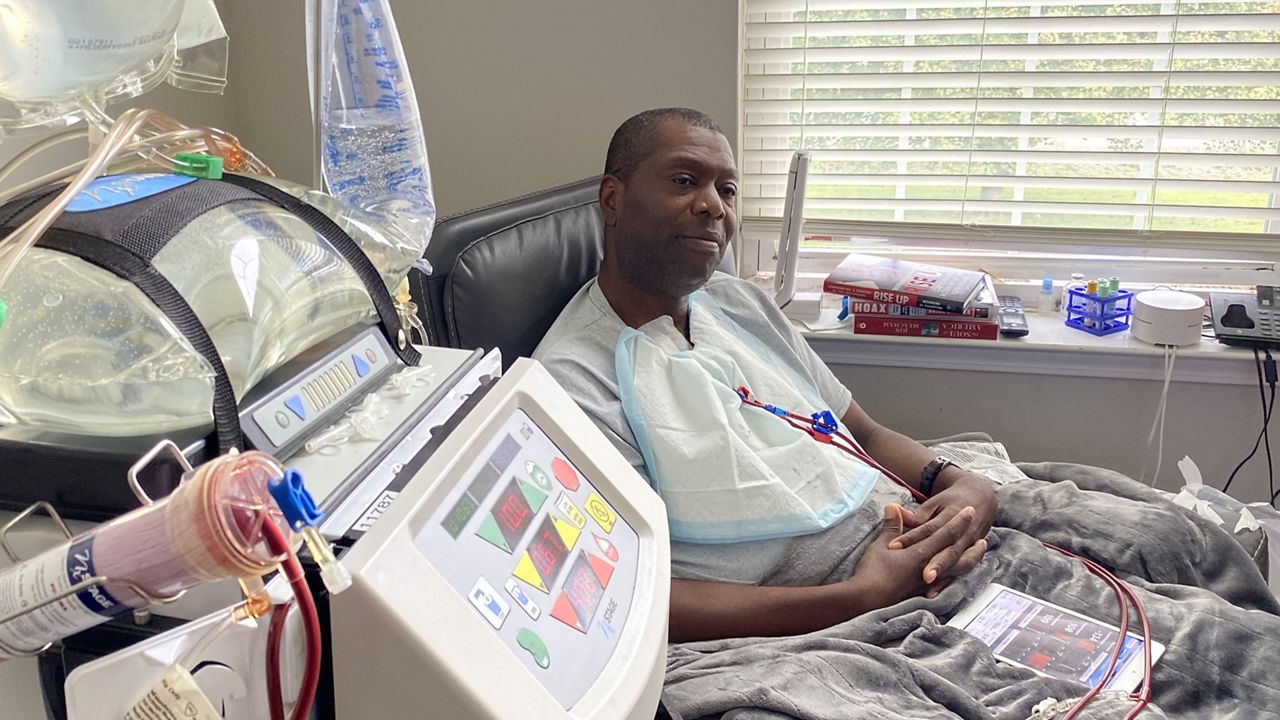
When Garrick Jackson heard doctors in New York City successfully transplanted a genetically altered pig’s kidney in a human patient, he was ready to sign up as a test subject.
“I would volunteer tomorrow. I think it’s the greatest thing because it’s so hard to get a match with my situation,” said Jackson. “They can do that, and the fact that it actually worked, that I saw the article, they actually had it on the person for like 50-something hours.”
The groundbreaking transplant occurred in October. According to NYU Langone, the pig kidney was attached to the body of a brain-dead patient who was kept alive on a ventilator.
“I saw that it worked, and I saw what the doctor said, and the color was fine,” said Jackson.
The news is not just an exciting prospect for Jackson, but it could be lifesaving.
He suffers from a rare form of kidney disease called glomerulonephritis. He was diagnosed at just 17 and has already had two kidney transplants. He needs another one, but the third time is more challenging.
“His antibodies are very high. So it’s very difficult to find a match,” said Jennifer Heindel-Jackson, Jackson’s wife.
Jackson, a registered nurse, believes this breakthrough could change the medical field, not only for people who immediately need a kidney, but also the more than 100,000 Americans currently on the organ transplant waiting list.
“It takes a long time to get a transplant,” Jackson said. “But if you can take a pig’s kidney, which means they can match yours, oh my goodness, the sky’s the limit. That would change, because it’s not just kidneys, it would be hearts, it would be livers.”
The long-term effects are still being studied, but Jackson and his family are hopeful.
“You know, a lot of people die waiting for a kidney. So if this is an option, that would extend his time with us and just give us back somewhat of a normal life for a while,” says Heindel-Jackson.
“I would be able to go back to work. I have more energy to spend more time with family. It gets to be a different life when you have your transplanted kidney,” said Jackson.
While the procedure was deemed a success, it will not be available for living patients for a while.
There are medical and regulatory processes that need to be followed. More than a half a million Americans with kidney failure depend on dialysis treatments to survive, largely because of the lack of human kidneys.

